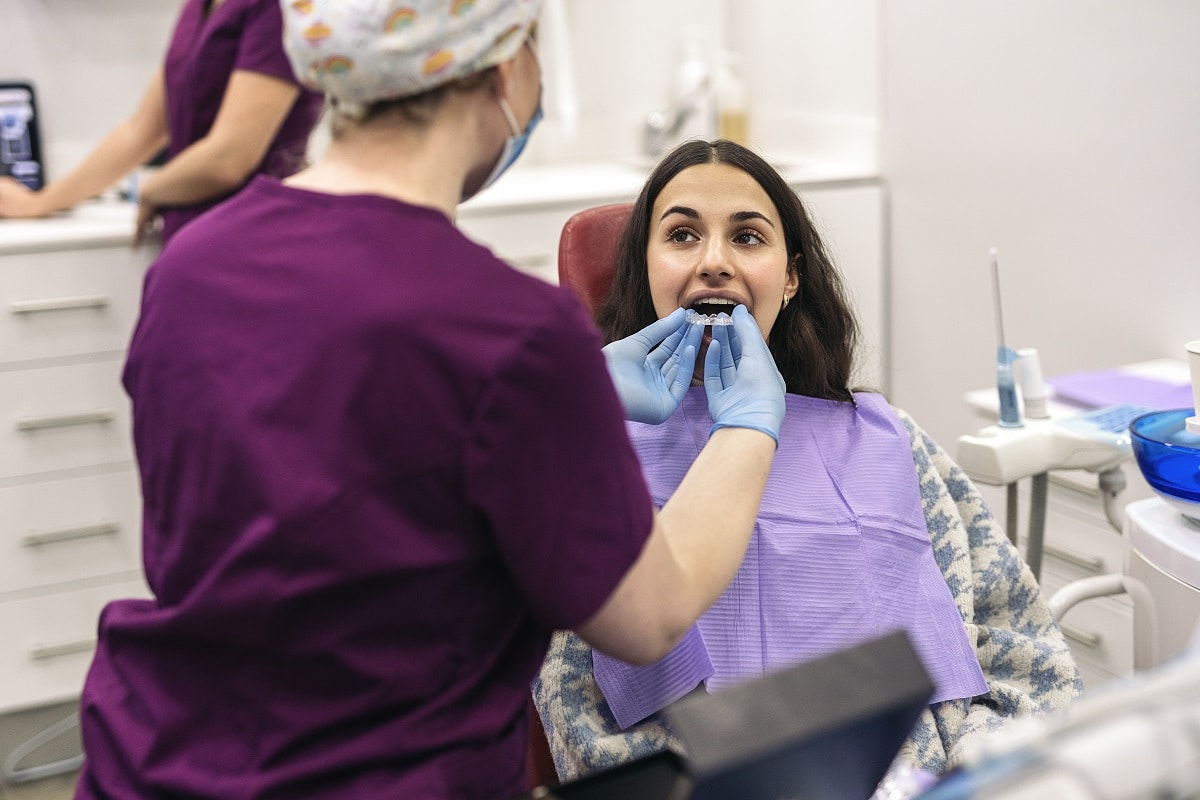
On a busy morning in Jericho, it is not unusual for someone to suddenly realize their Invisalign trays have been sitting in a case for days. Sometimes it happens after travel, a stressful work week, exams, illness, or simply falling out of routine. By the time patients from Syosset, Plainview, Hicksville, or nearby Nassau County communities try putting the trays back in, they often notice the same thing: the aligners suddenly feel painfully tight or will not seat completely.
That moment creates immediate panic. Many patients assume they ruined their results permanently or will need to restart treatment from the beginning. In reality, what happens next depends on how long the trays were left out, how much tooth movement was already underway, and whether the aligners are forced back in without professional guidance.
At Khan Orthodontic Group, we regularly help patients recover from interrupted aligner wear before small setbacks become larger treatment problems. If your trays suddenly feel too tight, no longer fit properly, or you are unsure what to do next, contact us for an orthodontic evaluation early can help prevent unnecessary delays and keep your treatment moving safely.

About Dr. Sabeeh Khan
Dr. Sabeeh Khan has been providing orthodontic care since 1992. He earned both his doctorate and orthodontic specialty certificate from Columbia University and has remained actively involved in leading orthodontic organizations throughout his career. His approach focuses on precise diagnosis, long-term smile stability, and patient education so treatment decisions remain practical, comfortable, and predictable.
Why do trays suddenly stop fitting after only a short break
One of the biggest misconceptions about Invisalign is that teeth stay frozen in position between tray changes. They do not.
Teeth are constantly responding to pressure from chewing, clenching, tongue posture, gum fibers, and surrounding bone. Invisalign aligners work because they apply controlled pressure consistently for most of the day. Once that pressure disappears, teeth begin drifting toward their previous positions surprisingly quickly in some patients.
This is especially common during stages where teeth were rotated, expanded, or recently moved into unstable positions.
Patients often describe the experience like this:
- “The tray almost fits except one side.”
- “The front teeth feel blocked.”
- “It snaps in halfway but leaves a gap.”
- “The aligner suddenly feels sharp or painful.”
Those details matter clinically because they help identify whether movement is minor or whether the tracking has been lost significantly.
The mistake patients make that creates bigger problems
When trays stop fitting, many people try to “push through it.”
That usually means:
- forcing aligners down aggressively
- biting hard into the trays
- skipping ahead to the next set
- wearing trays only at night to “ease back in”
- alternating between old and new aligners
This is where minor setbacks become more complicated.
Forcing poorly fitting aligners can create uneven pressure on teeth. Instead of moving predictably, certain teeth may stop tracking while others continue shifting. In some cases, attachments can loosen, teeth may tip incorrectly, or patients develop soreness that makes them stop wearing trays altogether.
At our office, we often see patients wait several weeks before calling because they hoped the problem would “fix itself.” Usually, early intervention creates simpler solutions.
How orthodontists decide whether you can continue the same trays
There is no universal answer because not all tracking problems are equal.
When evaluating interrupted wear, orthodontists look at:
- how long the trays were not worn
- whether the aligner still seats fully in the back teeth
- where visible gaps appear
- whether attachments still engage correctly
- how biologically responsive the patient’s teeth are
For example, a patient who stopped wearing aligners for four days may only need additional wear time before progressing. Another patient who paused for three weeks during a difficult rotation stage may require a previous aligner or mid-course refinement.
This is why guessing at home often delays progress unnecessarily.
Patients seeking Invisalign treatment in Jericho frequently assume discomfort automatically means the tray is “working.” That is not always true. Excessive tightness combined with incomplete seating usually signals loss of tracking rather than healthy tooth movement.
What happens if you leave the problem alone
Not every interruption becomes a disaster, but prolonged non-wear creates increasing unpredictability.
Early on, the biggest issue is usually minor tooth relapse. Later, more noticeable complications can develop:
- aligners no longer fitting at all
- attachments becoming ineffective
- bite changes during treatment
- unwanted spacing or crowding returning
- longer overall treatment time
- additional refinement trays
Some patients are surprised that even a few shifted teeth can affect the way the entire aligner fits. Invisalign systems are engineered around precise staging. When one tooth falls behind, it can disrupt the movement sequence for multiple others.
There are also behavioral patterns we commonly notice in real patients. Once trays stop fitting comfortably, wear time often drops even more because patients become discouraged. That creates a cycle where tracking worsens gradually over time.
The “one tray behind” strategy sometimes works, but not always
Patients often ask whether they should go back to the previous aligner.
Sometimes that is exactly what we recommend. Sometimes it is not.
If the previous tray still fits properly, it may help re-establish control before moving forward again. But if the teeth have already shifted beyond that stage, forcing older trays may create another mismatch.
This becomes particularly important during:
- expansion phases
- difficult canine rotations
- bite correction stages
- attachment-heavy movements
- cases involving previous crowding relapse
The safest approach is to determine which aligner still tracks accurately without excessive pressure.
A small gap in the tray can tell us a lot
One detail patients rarely notice is where the aligner lifts away from the teeth.
For example:
- front gaps may indicate incisor relapse
- back gaps may signal bite settling problems
- one-sided lifting may suggest rotational tracking loss
These patterns help orthodontists identify whether the issue is minor wear inconsistency or a larger staging problem requiring refinements.
At Khan Orthodontic Group, we also evaluate habits contributing to repeated tracking failures, including nighttime grinding, inconsistent wear schedules, frequent tray removal, or aligners left out during long social events or sports activities.
Patients receiving Invisalign treatment are often surprised that lifestyle patterns influence treatment predictability almost as much as the aligners themselves.
When you should contact your orthodontist instead of waiting
You should contact your orthodontist sooner if:
- trays no longer seat fully
- attachments feel loose
- sharp pain occurs in one isolated area
- aligners visibly warp or crack
- teeth appear to shift rapidly
- speech suddenly changes with tray insertion
- you stopped wearing trays for more than several days
The earlier the issue is evaluated, the more likely treatment can stay close to the original timeline.
Waiting usually reduces options.
Getting back on track safely
The good news is that most Invisalign interruptions can be managed successfully with the right plan.
Depending on your situation, your orthodontist may recommend:
- wearing the current trays longer
- temporarily returning to a previous aligner
- using chewies to improve seating
- rescanning for refinements
- adjusting wear schedules temporarily
- replacing damaged trays
What matters most is avoiding self-directed decisions that create additional tooth movement problems.
A short evaluation can often prevent months of unnecessary delay.
Get Professional Guidance Before the Setback Gets Worse
If your aligners suddenly feel tight, uneven, or no longer fit correctly, early evaluation matters. At Khan Orthodontic Group, we help patients throughout Jericho and nearby Long Island communities at our orthodontic office in Jericho determine whether treatment can be recovered with simple adjustments or whether refinements are needed. A timely orthodontic assessment can often prevent unnecessary delays, discomfort, and added treatment complexity.
Interrupted aligner wear does not automatically mean treatment has failed, but the way the problem is handled next can significantly affect the outcome. We encourage patients not to guess, force trays, or wait for the issue to resolve on its own. With accurate evaluation and timely adjustments, we can usually help restore progress safely while protecting long-term smile stability.
Frequently Asked Questions
How quickly do teeth move after stopping Invisalign?
Some patients notice tightness returning within a few days, especially during active movement stages. Biological response varies from person to person.
What if my aligners fit halfway but not completely?
Partial seating usually suggests tracking loss. Do not force the trays aggressively without professional guidance.
Can I skip to the next tray if my current one does not fit?
Usually no. Advancing prematurely may worsen tracking problems and create uneven movement.
Do I need to restart Invisalign completely?
Not always. Many patients can continue treatment with modified wear schedules, previous trays, or refinements.
Are tight trays normal after missed wear?
Mild tightness can happen. Significant pressure combined with visible gaps is more concerning.
What happens if I only wear Invisalign at night for a while?
Night-only wear during active treatment is typically insufficient and commonly leads to relapse or poor tracking.
Can attachments stop working if trays do not fit?
Yes. Attachments rely on proper aligner engagement to direct movement accurately.
Is it an emergency if trays stop fitting?
It may not be an emergency, but delaying evaluation often makes correction more complicated.